
Two decades of walking with rural Simbu communities.
CDA is a locally-grown, non-political NGO that has spent almost twenty years turning tribal conflict into peace agreements, garden plots into coffee income, and marginalised wards into organised, self-reliant communities.
A peaceful, organised and self-reliant community focused on improved, sustainable livelihoods.
Mission
Promote and support community socio‑economic participation, and grow sustainable livelihood activity that improves family quality of life.
Goal
Strengthen networks, build capacity and open opportunity for young women and men as agents of change in their own communities.
Approach
Enter communities, empower and train them, and guide the formation of community‑based organisations that can sustain themselves.
- Network with health-sector stakeholders to deliver training and raise awareness on health issues.
- Improve the sustainability of natural resource use across CDA's operating districts.
- Increase families' income-generating opportunities and improve their livelihoods.
- Create real opportunities for families to improve their overall quality of life.
A community-grown NGO, twenty years into rural Simbu.
Community Development Agency (CDA) began as the brainchild of Yanny Smith Guman after more than a decade working alongside NGOs in some of Papua New Guinea’s most remote communities. Registered with the Investment Promotion Authority in 2001, CDA began operating as an NGO in 2005 — first in Gumine District, then, from 2020, across all six districts of Simbu Province.
Registration & identity
- Legal name
- Community Development Agency of Papua New Guinea (PNG) Inc.
- Date of formation
- 15 October 2001
- Registration authority
- Investment Promotion Authority (IPA), PNG
- Registration number
- 5‑1420, under s.7 of the Association Incorporation Act
- Operating as an NGO since
- 2005
- Head office
- Non‑Formal Education Section, Division of Education, Kundiawa 461, Simbu Province
Why CDA exists
More than 70% of Papua New Guinea’s population lives rurally, with life outcomes well behind urban centres — a gap CDA’s twenty years of observation trace to weak government presence and a lack of leadership focused on rural development. CDA’s response: enter communities on their own terms, understand how they live, and grow interventions that are actually sustained by the people who receive them.
A six-week rhythm, repeated for every project
Planning workshop
Project teams and communities set the plan together before any activity begins.
Implementation
Field activity delivered by project coordinators, officers and community resource officers.
Community entry
Return to community to check progress, listen, and adjust.
Reporting & evaluation
Narrative and budget acquittals prepared at the project management unit level before the cycle repeats.
Tribal fighting causing large-scale destruction to livelihoods and natural resources
Poor health conditions across rural wards
Dysfunctional government and an ineffective leadership system
Over-exploitation and degradation of natural resources
Limited income-generating opportunities and access to resources
Community marginalisation and entrenched poverty
Abuse and misuse of already-limited resources
- Young men and women trained as community facilitators
- Model families supported to lead by example
- Clan and community groups organised as CBOs
- Community leaders and committees who lead those CBOs
- Women leaders and women's groups
- Village court officials, mediators and informal community leaders
- Ward councillors and ward development committees
- Youth groups, schools, students, farming groups and public servants
- Church organisations and community institutions
- District Management Teams across all five districts
- Other NGOs within Simbu Province and beyond
Seven focus areas, one community-first method.
From coffee gardens to court houses, CDA’s programs sit inside seven sectors — each one searchable below alongside the partners and projects that fund it.
Agriculture
- Fresh produce
- Bee keeping
- Inland fish farming
- Coffee production & SME income
Health
- WASH
- School health project
- Food processing & nutrition
- HIV/AIDS, COVID-19 & TB awareness
Social
- People's empowerment
- Capacity building
- Leadership & action
- Youth mobilisation & sports
- Gender training & empowerment
- Children's protection
- Safe house / Centre of Influence
Law & Order
- Peace building
- Conflict resolution
- Win-win conflict prevention
- Mediation & restorative justice
Infrastructure
- Buildings
- Resource centres
- Water supply
- Maintenance
Environment
- Climate change & mitigation
- Reforestation
- Water resource management
Education
- Youth life skills (I-Home)
- School support & pathways
- Certificate & Diploma training
Programs & partners database
Every funded program CDA has delivered since 2005, drawn straight from CDA’s official partnership records. Filter by sector, search by partner, program or year, then export what you see.
Gender-Based Violence & Safe House Project
K500,000GBV response training, awareness raising, and construction of a Safe House / Centre of Influence for survivor referral and support.
Sustainable Rural Development & Social Business Enterprise
K4,800,000CDA's current flagship program, shifting its coffee work from a charity model to a social business — green-bean processing, roast-and-ground retail coffee, and continued CBO strengthening.
Gender, GBV & Sorcery-Accusation Violence Project
K300,000Training and referral pathways addressing gender-based violence and sorcery-accusation-related violence (SARV).
Infrastructure Development — Simbu Education Resource Centre
K50,000Seed funding toward the Simbu Education Resource Centre (SERC), now under construction.
Gender & Women Empowerment Project
K150,000Gender-rights training, social action analysis and advocacy on gender-based issues.
Climate Change Adaptation & Mitigation Project (GEF)
K125,000Climate change mitigation delivered under the UNDP Global Environment Facility.
Cultural Preparation & Revival Project
K130,000Supported cultural preservation and revival activity within Simbu communities.
Climate Change Mitigation & WASH Project
K927,000Combined climate-change mitigation with water, sanitation and hygiene delivery.
Coffee Development Project (PPAP)
K2,200,000The largest coffee-industry support project in Gumine and neighbouring districts — reached over 3,000 smallholder farmers with pulpers, nurseries and three wet mills.
Governance Project — Ward Planning
K927,000Delivered 45 ward development plans, three consolidated LLG plans and a Gumine District political assessment, in collaboration with ANU and DFAT.
Conflict Resolution — Win-Win Mediation & Restorative Justice
K760,000Peacebuilding and mediation training that underpinned CDA's later success brokering tribal peace agreements.
Livelihood Program
K106,000An eight-year program spanning food production, small livestock, inland fishing, beekeeping and coffee-based income generation.
WASH Project
K127,000Water, sanitation and hygiene infrastructure delivered to rural Gumine communities.
Community Peace Building
K347,000Facilitated major community peace agreements that ended long-running tribal conflicts across Gumine District.
Climate Change Adaptation & Mitigation Project
K130,000Introduced climate-resilient crops — early-maturing sweet potato, drought-resistant cassava — and famine-food cultivation.
Rural Socio-Economic Development Project (Phases I & II)
K5,250,000CDA's longest-running program — funded three coffee wet mills, CBO strengthening, and early planning for a community development institute.
Environment Conservation & Awareness Project (Phase II)
K15,000Continuation of conservation and environmental-awareness work across Gumine communities.
CDA Capacity & Organisational Strengthening
K230,000Strengthened CDA's own governance, internal systems and staff capacity as an organisation.
Community Mobilisation & Empowerment
K146,000CDA's founding program — early community organising and mobilisation training that shaped how CDA still enters and empowers rural communities today.
Environment Conservation & Awareness Project
K39,000Worked with landowners to identify and conserve water sources, and ran community awareness on environmental protection.
Amounts and partnership years are reproduced from CDA’s 2024 Capability Statement & Profile. Several line items in the source ledger record additional funding tranches under the same program; figures shown here are grouped by program for readability and may not resolve to the document’s headline total (K14,452,000) to the kina.
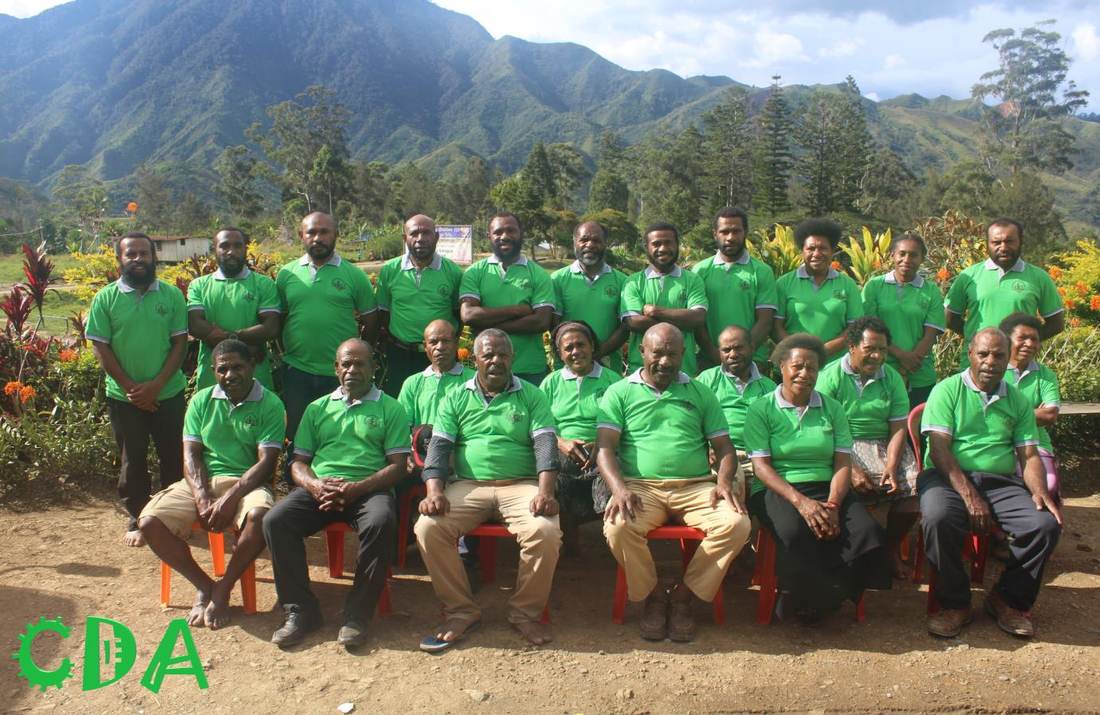
The people behind CDA
A seven-member Board sets direction; a management and field team — several with 15–18 years at CDA — carries it out. Search by name, role or expertise.
Assistant District Manager
Leading human rights activist
Entrepreneur
Executive Director, CDA
Pastor
Teacher
Member of Parliament
Program management, project implementation, planning, M&E, financial management, project design & documentation
Property management & valuation, land administration, feasibility studies, project management, district administration
Finance, accounts, operations, asset management, human resources
Program planning & management, financial management, mobilising churches & community groups, youth empowerment
Project management, implementation, planning, M&E, project design and coordination
Policy development, tutoring, telecom network engineering, database design & management, systems administration
Accounts, finance, administration
Community development, social work, training and advocacy
Gender-issues trainer, community development trainer and advocate, church trainer
Community organisation work, environment
Empowerment, project implementation and coordination
Teacher, trainer, child trainer, disability empowerment and training
Building design, builder, construction manager
Computer support, graphic artist, web designer
Agriculture, coffee, farming, pastoral work
Property management, project planning, land administration
Where we work
CDA’s roots are in Gumine District; since 2020 the same model has extended province‑wide.
Gumine District
CDA's founding district and the site of most delivered infrastructure: three coffee wet mills, 45 ward development plans, and the peace agreements that ended conflict across dozens of tribes.
Kerowagi District
Includes the Kup and Salt Nomane Karamui local-level government areas; coffee development and WASH activity extended here alongside Gumine.
Kundiawa–Gembogl District
One of Simbu's most recent priority districts for CDA's rural socio-economic development programming.
Sina Sina–Yonggomugl District
Brought into CDA's operating footprint as part of the province-wide extension from Gumine.
Salt-Nomane-Karamui District
Home to Doliba and Nomane High Schools, recipients of a library-book donation project developed with SASA and Project Yumi.
Chuave District
Named in CDA's 2020 province-wide extension alongside Simbu's other five districts.
Structure, board & safeguards
A flat, accountable operating structure sits behind every program above — from the Board down to community resource officers in the field.
Structure shown for CDA’s Rural Socio‑Economic Development (RSED) Program, Phase II.
Financial management
All programs run on a documented financial operating manual with standard reporting, budget acquittal and evaluation forms. CDA’s books and accounts pass through external audit every six months, with both narrative and financial audit reports prepared internally beforehand.
Since 2005, more than sixteen partners have channelled in excess of K8 million through formal agreements into Gumine and the wider Simbu districts — without a recorded breach of law or policy against government or regulatory bodies.
General Body & workforce
- General Body members
- 72 (43 men · 29 women) — meets annually to approve plans & budget
- Board of Directors
- 7 members (4 men · 3 women), 2‑year terms
- Regular staff
- 16 (12 men · 4 women)
- Community facilitators / volunteers
- 12 (9 men · 3 women)
- Ward development committees supported
- 450
- Model farmers & health volunteers
- 1,700 model farmers · 40 health volunteers
Documented systems behind every program
Human Resource Operating Procedure Manual
Sets down the policies, conditions, rights and obligations governing CDA staff.
Accounting & Financial Procedure Manual
The basic framework for reaching CDA's financial goals economically and efficiently.
Safeguarding & Child Protection Policy
Establishes child rights at every level of the organisation and in the communities CDA serves.
Complaint Mechanism Policy
Ensures every stakeholder can raise feedback or complaints and have them properly addressed.
Family Model Approach Strategy
Promotes community socio-economic participation to improve family quality of life.
Gender Policy
Establishes gender equality across every level and function of the organisation.
Disability Inclusion Policy
Ensures people with disabilities are included in the delivery of CDA's work.
Women Economic Empowerment Strategy
Promotes equal opportunity for women to participate in and benefit from profitable economic activity.
Performance Management System
Improves CDA's overall organisational performance and program delivery quality.
Role Description of Staff
Defines each role's purpose in achieving CDA's organisational goals and objectives.
Accounting Software (QuickBooks)
Improves the organisation's financial management system.
Website
Shows partners and the public what CDA does, and opens a channel for feedback.
Access Database
Records, sorts, classifies and processes all project and organisational data efficiently — the same principle this site's search is built on.
Where CDA can plug in next
Twenty years of trusted, on-the-ground delivery gives CDA a running start with new partners — government, donor or private sector.
CDA is ready to…
- Partner across every sector of government, provincial to local level
- Build ward-level development plans through an approved bottom-up process
- Work with the Health Department to extend WASH access to communities, schools and clinics
- Deliver climate change adaptation and mitigation projects at scale
- Support agriculture across every sub-sector CDA already works in
- Build financial management, governance and infrastructure capacity for schools
- Work the coffee value chain end to end — tree to cup
- Deliver organisational development support to peer CBOs and NGOs
- Bring a proven community-ownership approach to new, jointly-funded initiatives
Going forward
- Formalise partnerships with government sectors to deliver shared services
- Report CDA's work into official Government reporting channels
- Leverage a workable, twenty-year-tested project delivery approach for Government service delivery
- Complete the Simbu Education Resource Centre (SERC) with co-funding support
Co-funding for the Simbu Education Resource Centre (SERC) — a state-of-the-art facility with uninterrupted internet, an e-library and business services for students on alternative education pathways.
Ready to start a conversation?
Reach CDA’s Executive Director directly — details on the Contact page.
Contact CDA
Yanny Guman
Sharing this profile offline
A complete single-file copy of this profile — every program, person, district and policy, with the CDA emblem and photography embedded — can be downloaded from the Offline copy button at the top of the page. It opens in any browser with no internet connection, and can be emailed or copied onto a USB stick for partners in the field. Use Print / PDF to produce a printable version of the whole profile.